Issues with Matched-Lapped Cylinder Block and Valve Plate Assemblies

A technician with over a decade of experience in hydraulic piston pump repair undertook the servicing of an A4VG180 pump used on a concrete pump truck. He purchased a domestically manufactured cylinder block and valve plate. Upon inquiry, he learned that these parts had been matched and lapped at the factory. When he received the components, he carefully inspected the mating surfaces and confirmed they had indeed been lapped. To be absolutely certain, he used red lead paste to verify the fit accuracy of the friction pair; the test revealed two parallel contact marks on the cylinder block's mating surface. Satisfied, he assembled the pump and mounted it on a test bench to begin evaluation.
The test bench for this closed-loop pump utilized manual relief valves to apply load to ports A and B, without computerized curve displays. During testing at a motor speed of 1000 rpm, the technician monitored several parameters:
1) flow rate at port A;
2) pressure changes at port A during loading;
3) pump housing leakage;
4) charge pump pressure;
5) pressure at the servo piston (port A side) on the pump body.
When loading port A, the pump housing leakage increased in tandem with the rising pressure at port A. As the pressure approached 200 bar, the flow rate at port A dropped below 80 L/min, while housing leakage exceeded 100 L/min. This indicated a failure of the port A relief valve. Testing on port B yielded the same results. Consequently, the technician disassembled and inspected the relief valves for both ports, discovering scoring marks on the conical surface of the pilot valve spool. After refinishing the conical surface and reinstalling the valve, the maximum achievable load pressure improved but capped out at 240 bar. Further repairs to the relief valve resulted in only marginal pressure increases. After repeated repairs and tests, the port relief valve pressure plateaued at approximately 300 bar and would not rise further. Despite these extensive efforts, the results were unsatisfactory, prompting a deeper analysis of the problem: what had been overlooked or done incorrectly? I decided to examine the test data more closely. This time, I discovered that as the pump's load pressure increased, the flow rate at Port A decreased—showing an inverse relationship—yet the pump housing leakage had not increased. So, where was the flow going? Skeptical, I disassembled the pump and found the following:
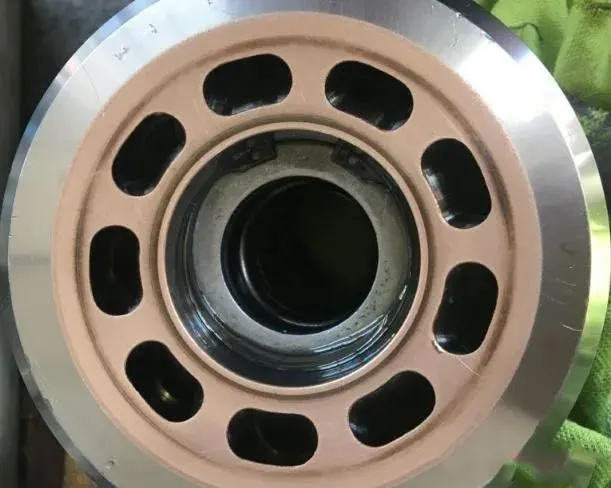
Friction marks are present on both sides of the inner and outer sealing bands of the suction and discharge ports on the cylinder block's port face, whereas the mating lapping marks on the sealing bands between the ports remain visible.
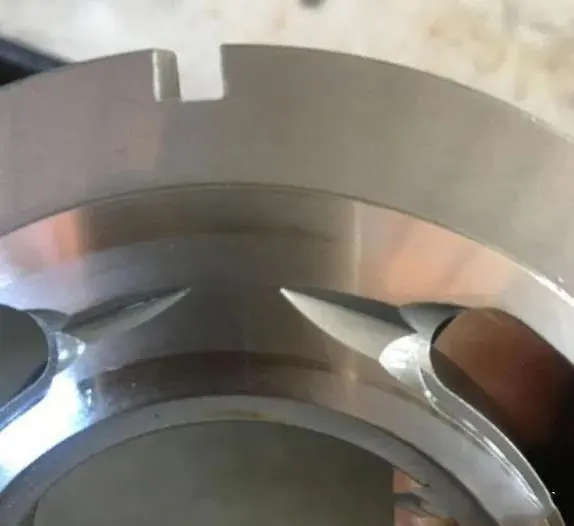
A closer inspection of the valve plate reveals friction marks on both sides of the inner and outer sealing bands—specifically adjacent to the suction and discharge ports—while the original lapping marks remain visible in the central areas between these bands. This indicates that, under hydrostatic oil film conditions, there is an excessively large clearance in the regions between the suction and discharge ports; consequently, the outer sealing band of the valve plate lifts away from the cylinder block's mating surface under pressure, creating a leakage path. During pump testing, this allows oil from the high-pressure zone to bypass—via the noise-reduction grooves on the valve plate—to the low-pressure side, resulting in a failure to build pressure and a reduction in flow rate, rather than internal leakage into the pump housing itself.
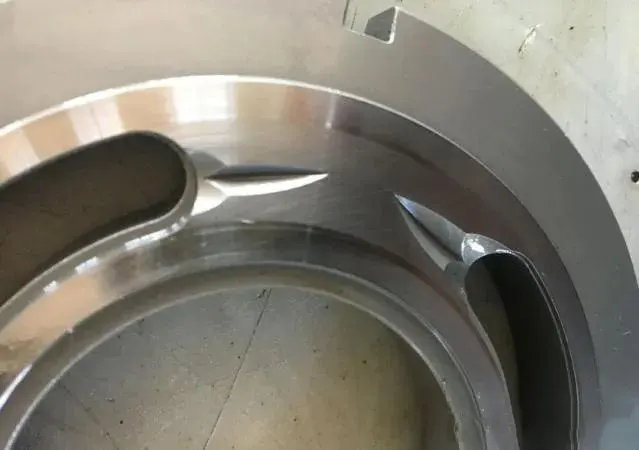
When the pump failed to reach the required calibrated pressure during testing, the technician mistakenly attributed the issue to the port relief valve; repeatedly servicing the valve wasted time and effort without addressing the root cause.
After manually re-pairing and lapping the friction pair and reassembling the pump, the unit passed all tests perfectly. The problem was resolved, yet I remain puzzled as to what manufacturing methods and processes the pump component manufacturer used to produce a valve plate exhibiting such a concave deformation.
